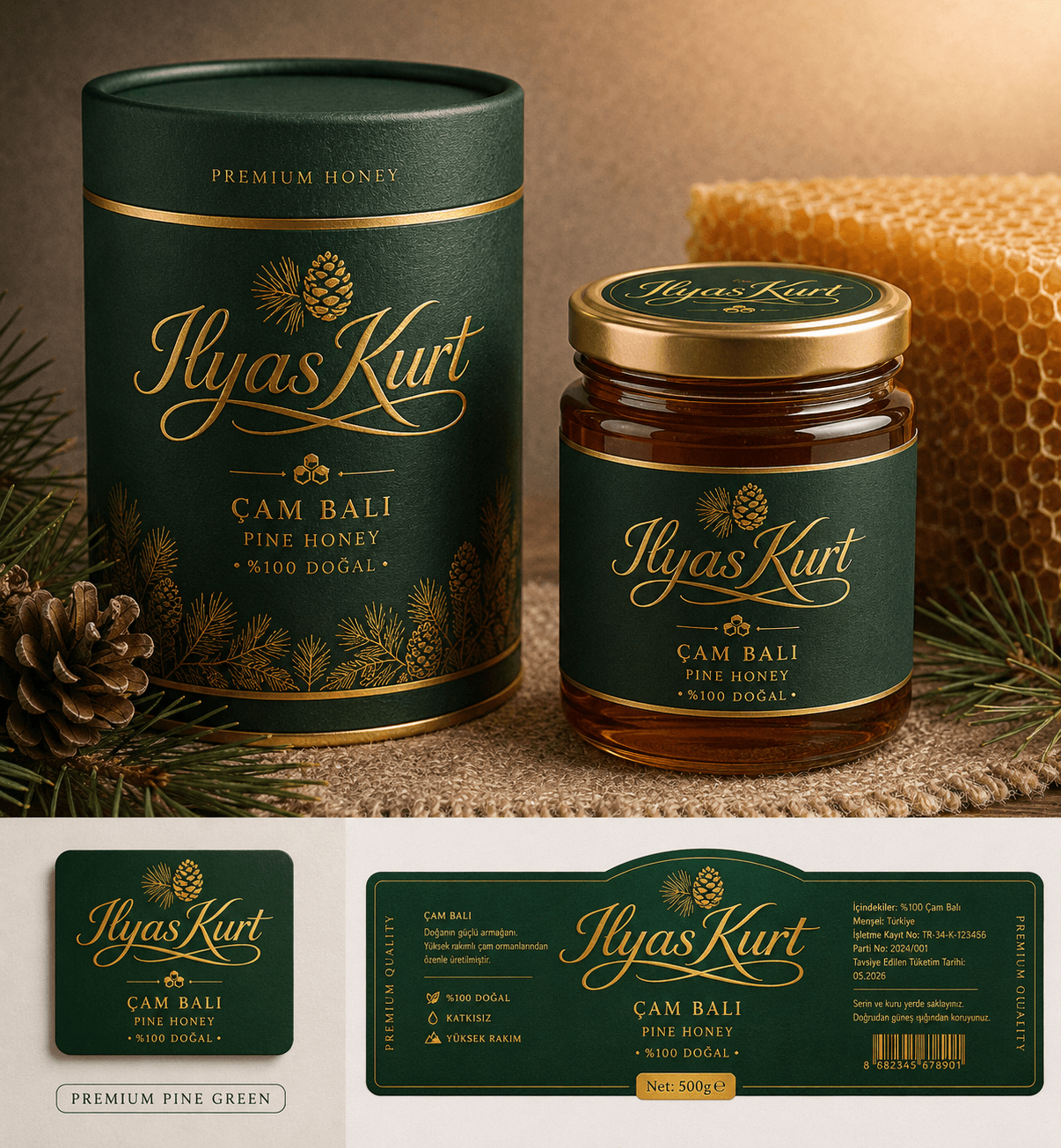
The Science of Pine Honey
2 min read · Published August 18, 2026
Not flower honey — honeydew honey
Pine honey forms differently from what most people picture when they think of honey. It doesn't come from flower nectar, but from the sweet secretion left on pine trees by a scale insect, Marchalina hellenica — this type of honey is called "honeydew honey." Bees collect this secretion and process it with their own enzymes before storing it in the hive. Turkey accounts for the large majority of the world's pine honey production, which makes pine honey both a production and a research topic closely tied to Turkey specifically.
A physically and chemically distinct honey
Pine honey's physicochemical profile differs markedly from flower honeys. Studies show pine honeys carry higher C4 sugar content, higher proline (an amino acid used as a quality marker), higher diastase enzyme activity, and higher acidity than blossom honeys, while blossom honeys tend to have higher moisture and HMF (hydroxymethylfurfural, a heat/aging marker) values. Pine honey is also known for its low tendency to crystallize, which keeps it liquid for longer.
Phenolic composition: protocatechuic acid leads
A 2022 study screened 17 pine honey samples collected from Turkey's Aegean region against 18 phenolic compound standards using HPLC. The findings showed protocatechuic acid as the dominant phenolic compound in the samples (ranging from 197.8 to 780.2 micrograms per 100g), with p-hydroxybenzoic acid and benzoic acid as the second and third most prevalent compounds. This phenolic profile forms a chemical "fingerprint" specific to pine honey — one that can be used to distinguish it from other honey types.
Bottom line
Pine honey isn't just a different flavor profile — it comes from an entirely different biological source and carries a measurable chemical identity of its own. This is a scientifically documented part of Turkey's honey diversity, and the chemical explanation for why pine honey behaves so differently from flower honeys: its resistance to crystallizing, its thick texture, its characteristic taste.
İlyas Kurt Editor's Note
Turkey's share of world pine honey production is a real agricultural and scientific data point — it's part of why we take pine honey seriously as its own product at İlyas Kurt, not a romanticized marketing story.
Sources
Every claim above draws on the sources below. Where the evidence is limited or preliminary, we've said so.
Identification of the Main Phenolic Markers in Turkish Pine Honeys and Their Biological Functions
Sahin H, Ozkok A, Tanugur Samanci AE, Onder EY, Kolayli S — Chemistry & Biodiversity, 2022
Study type: Laboratory analysis (17 honey samples, HPLC)
Key finding: In 17 pine honey samples from the Aegean region, identifies protocatechuic acid as the dominant phenolic compound (197.8-780.2 micrograms per 100g), with p-hydroxybenzoic and benzoic acid as the second and third most prevalent.
Limitations: Sample limited to a single geographic region (Aegean); a laboratory composition analysis, not a source of clinical/human-health data.
DOI: 10.1002/cbdv.202200835View source →